
Dopplium Radar System Installed at TU Delft's MS3 research group
We are excited to announce the installation of a new Dopplium radar system at the Microwave Sensing, Signals and Systems (MS3) research group at Delft University of Technology.
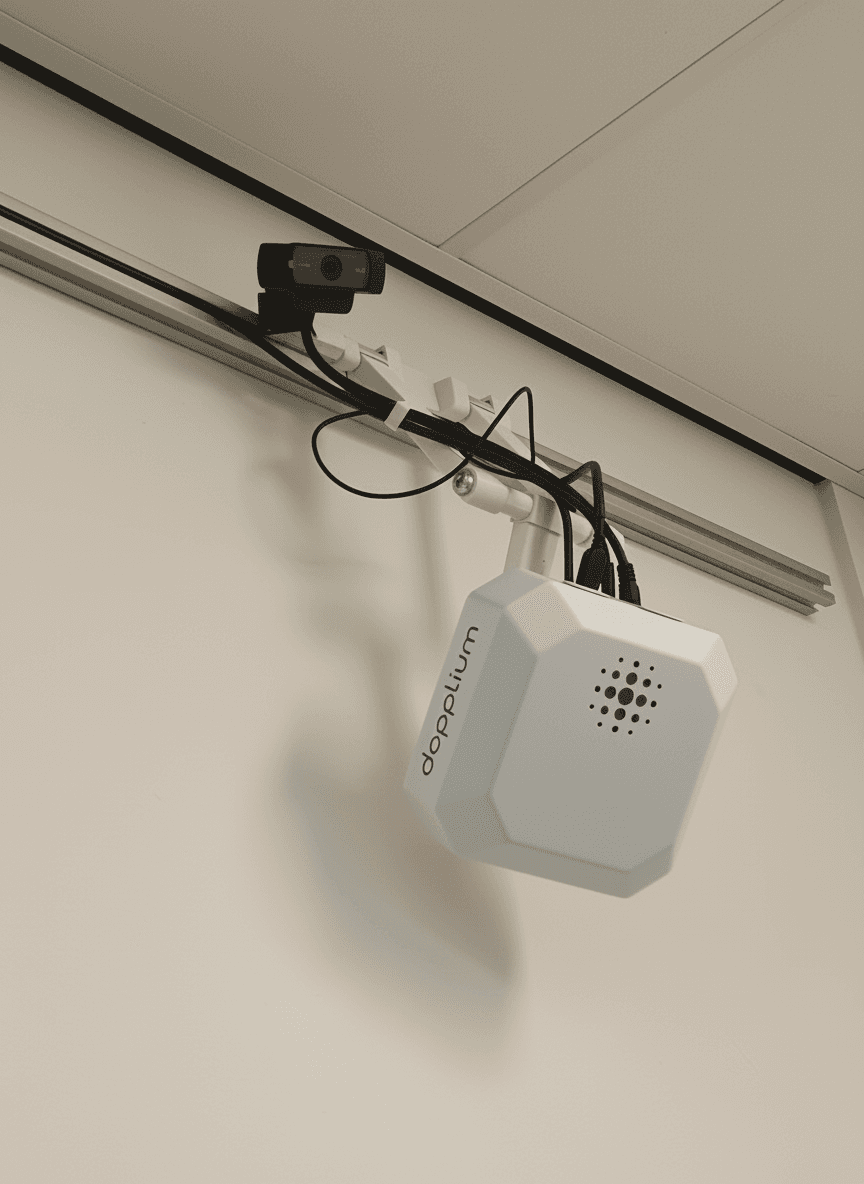
We are excited to announce the installation of a new Dopplium radar system at the Microwave Sensing, Signals and Systems (MS3) research group at Delft University of Technology. This deployment marks an important milestone in our mission to support cutting-edge academic research with high-performance, easy-to-use radar technology.
The system consists of three customised plug-and-play Dopplium radar nodes, designed to help researchers capture high-quality indoor human-monitoring data for next-generation, non-invasive healthcare applications. The installation combines precise synchronisation, flexible waveform control, and seamless multi-sensor operation, features that are often challenging for researchers to obtain in a reliable and streamlined setup.
Simplifying Multi-Sensor Radar Experiments
Anyone who has worked with radar sensing in research environments knows that collecting data from multiple sensors can be complex. Issues such as manual triggering, cable management, and fragmented software tools often slow down progress.
To address these challenges, Dopplium provides a system where a single computer controls all radar nodes simultaneously. This drastically simplifies the workflow:
- One interface configures all devices
- One click starts synchronized data recording
- All sensors run predictable and reproducible experiments
- Activity labels and metadata are automatically logged
This level of integration reduces experimental overhead and allows researchers to focus on algorithm development, testing, and scientific insight, not on system setup.
Key Features of the Installation
1. Customised Plug-and-Play Radar Nodes
The installation includes three ceiling-mounted Dopplium radar units, customised specifically for TU Delft researchers. These units include requested hardware and firmware features, and are designed for rapid deployment in flexible laboratory environments.
2. Raw ADC Data Recording with Full Waveform Configuration
Each Dopplium node provides timestamped, high-resolution ADC data with complete control over waveform parameters. This enables:
- Precise synchronisation across all sensors
- Full reproducibility of experiments
- High-fidelity signal processing opportunities
- Support for advanced algorithm development, including micro-motion, vital-sign detection, and multi-target tracking
3. Multi-Radar Synchronisation and Unified Software Control
All three radars operate in exact time alignment, ensuring coherent data capture across the whole installation. The Dopplium software suite:
- Controls all nodes from one machine
- Applies consistent settings across devices
- Logs experimental metadata and activity descriptions
- Helps researchers organise and label experiments efficiently
This removes one of the largest bottlenecks in multi-sensor radar research.

Dopplium software interface showing global healthcare node control, transmission management, and patient activity event logging
4. Radar-Camera Synchronized Data Capture (Camera Used Only for Labeling)
To support machine-learning datasets, a camera is included solely for ground-truth labeling. The vision system is not used for sensing. Dopplium remains a privacy-preserving, non-invasive solution, with the camera only providing annotations researchers can later remove or anonymize.
Supporting Multiple Research Themes at TU Delft
This installation empowers the MS3 group to advance research in several high-impact domains:
- Elderly care monitoring: enabling fall detection, mobility assessment, and behavioural analysis without cameras.
- Privacy-preserving vital-sign sensing: detecting breathing and heart rate without physical contact.
- Smart-building perception: enabling occupancy estimation and activity classification.
- Continuous patient monitoring and behaviour analysis: supporting long-term, unobtrusive monitoring in healthcare environments.
Radar sensing has the unique advantage of being robust, privacy-friendly, and capable of detecting micro-motions invisible to cameras. This makes it particularly well suited for sensitive healthcare applications.